I’ve been thinking about higher ed a lot (even more than usual) these days, as it’s facing some challenging times, so I’ll be posting a bit more higher-ed focused content on here.
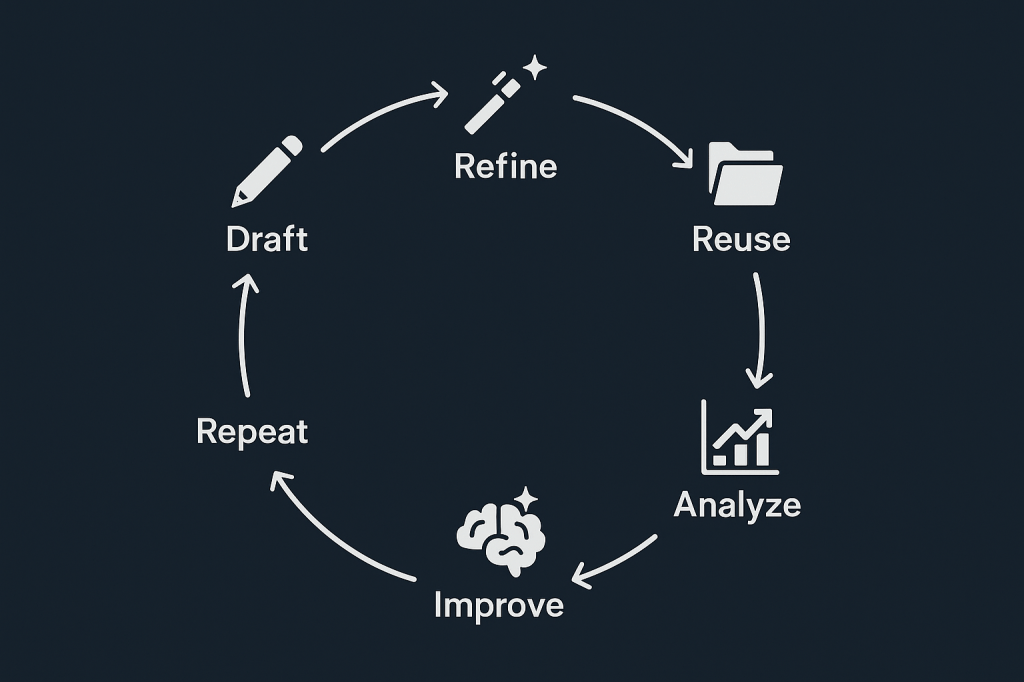
AI isn’t just another way to save a few minutes on your next campaign. For marketers in higher ed, it offers a lot more. In fact, if used wisely, it can become a system that makes every piece of work more efficient, more insightful, and more effective the more you use it. It’s often referred to as the AI Flywheel.
Let’s take a look at how higher ed marketing teams can move beyond one-off AI prompts and quick fixes, and start building systems that get smarter, faster, and more valuable with each cycle. If you’re spending too much time feeling like every enrollment or giving campaign is a new lift (like planning Welcome Week for the third time in six months), this approach will help you shift from reinvention to momentum.
Why AI in higher ed is not just about faster emails
Higher ed marketers operate in a world defined by big challenges and limited resources. Budgets are tight, teams are lean, and institutional expectations keep growing. And yes, you’re still somehow expected to write like a copywriter, strategize like a VP, and test like a CRO, all before lunch.
Think about it like this: You don’t want a robot that spits out a decent subject line when you ask. Instead, you want to me more ambitious and develop a process that helps your marketing team get sharper, learn from every email sent, and make the next campaign even more relevant, personalized, and achieve better results.
What is the AI Flywheel?
The AI Flywheel is a feedback loop with the intention to compound value. Instead of approaching tasks in isolation, the AI Flywheel connects every prompt, every campaign, and every data point so that the next round is always easier and more effective.
For example:
- Ask AI to draft initial content for anything from an email to an event invitation.
- Refine the output, shaping the tone and content to match your institution’s brand, tone, and values.
- Reuse the structure or logic behind successful outputs for new use cases or audiences.
- Analyze the response data. Did students click more? Did parents open less? What seemed to resonate?
- Feed those insights right back into the next prompt, so that each turn becomes faster and smarter.
Instead of improving by accident, you develop a plan. Your systems, prompts, and institutional knowledge compound, which can make each campaign more agile and aligned.
How to build an AI Flywheel in higher ed marketing
Here’s how your marketing team can get started:
1. Design prompts for systems, not just single results
Don’t just ask AI to “write a welcome email for new students.” Instead, break the campaign down and think in terms of building blocks you and your team can reuse across future projects.
For a student welcome series, your AI prompt structure might include:
- A general template with modular sections (intro, campus highlight, quick next steps, CTA)
- Personalization variations (first-generation, out-of-state, transfer)
- Follow-up text messages
- Web teasers for cross-channel promotion
Whenever possible, capture not only the result but also the reusable logic and variants. This way, your initial prompt seeds a content system rather than a one-and-done piece.
2. Create a living context file
AI is only as good as the context you give it. Feed your key institutional inputs into your AI companion or prompt library:
- Brand voice and tone (welcoming, inclusive, aspirational, empathetic)
- Personas (prospective students, parents, alumni, faculty, donors, employers)
- Differentiators (small class sizes, experiential learning, first-year programs)
- Strategic goals (increase applications, grow out-of-state reach, boost giving, increase student retention)
Example:
“Using our brand voice, draft a headline and subhead for our rural-first-gen scholarship landing page.”
Your context doc becomes a shared institutional brain, without needing to Slack a coworker for that one tagline she wrote back in 2019.
3. Turn every output into a future input
Every campaign, message, or landing page is a learning opportunity. Once you send an email with great open rates or a text message that parents forward widely, don’t just celebrate and move on. Feed that result back into your AI system.
For instance, prompt your tool with:
This open house email had a 52% open rate and strong parent engagement. Use it as a model to draft a campaign for our admitted student event.
This way, you’re building institutional intelligence that compounds, turning AI into a digital team member who remembers what worked (and what fell flat) last semester, last year, and beyond.
4. Systematize with a prompt library
Organize your prompts and templates so you’re never starting from scratch. Think of this as your team’s living playbook, where you collect and annotate things like
- Outreach plan evaluations
- Donor message variants based on giving history
- Career-focused homepage copy
- Accessibility and language audits
- Infographic summaries
This living library becomes more valuable with each project, which can help make every new campaign both faster and more targeted.
Benefits of the AI Flywheel for higher ed teams
Scalable personalization: AI enables you to deliver tailored messaging, but the flywheel structure prevents your small team from reinventing the wheel with every campaign.
Consistent messaging: Centralized inputs, living prompt libraries, and reusable assets mean that your voice, values, and strategy show up seamlessly wherever your audience is.
Smarter and faster decision-making: Data feeds back into your system after every initiative, enabling rapid learning and focused improvements instead of guesswork.
Sustainable marketing systems: Even with staff changes or shifting priorities, your documented systems make it easy for new team members to ramp up and keep improving what’s working best.
How to get started
You don’t need a large team or a massive investment to begin. Start small and intentionally:
- Save your three most-used prompts and tweak them with every cycle
- Keep a shared doc with core messaging, personas, and brand guidelines
- Make a habit of reviewing results and adding insights back into your system
Over time, your flywheel will pick up speed, giving your institution compound returns and marketing agility.
What about you? Have you started working on your AI Flywheel?

 lead up
Leave a comment