

Your Content Contributors Have Other Jobs – Build Your Content Management Accordingly
Picture this: A department coordinator is logging into their university’s CMS for the first time in eight weeks. She needs to update an application deadline, and she has about fifteen minutes before her next meeting. Since her last website update, she has helped organize an event, answered a ton of student questions, supported several faculty…


Don’t Spend Millions to Make the Same Website Prettier
There’s something satisfying about a website redesign. You get new colors, cleaner templates, better typography, a modern homepage, and maybe a new navigation system and some impressive components for telling stories. The new site launches. Everyone celebrates it. Yay! And six months later, many of the same problems are back: Pages are outdated. Navigation is…

Agenda Items You Should Never Put in an Email
We have completely normalized a specific complaint in our workplaces: “This could have been an email.” And most of the time, this complaint is justified. Meetings that exist solely to report information, share status updates, or recap decisions already made are a massive drain on productivity. They waste time and absolutely should be relegated to…

How to write helpful alt text
Most people treat alt text like a checkbox. They add a quick description and move on. Requirement fulfilled. That instinct is understandable. Alt text feels like a technical requirement tucked away in an image settings panel. It’s something you handle at the end, not something you think carefully about. Unfortunately, that mindset produces alt text…
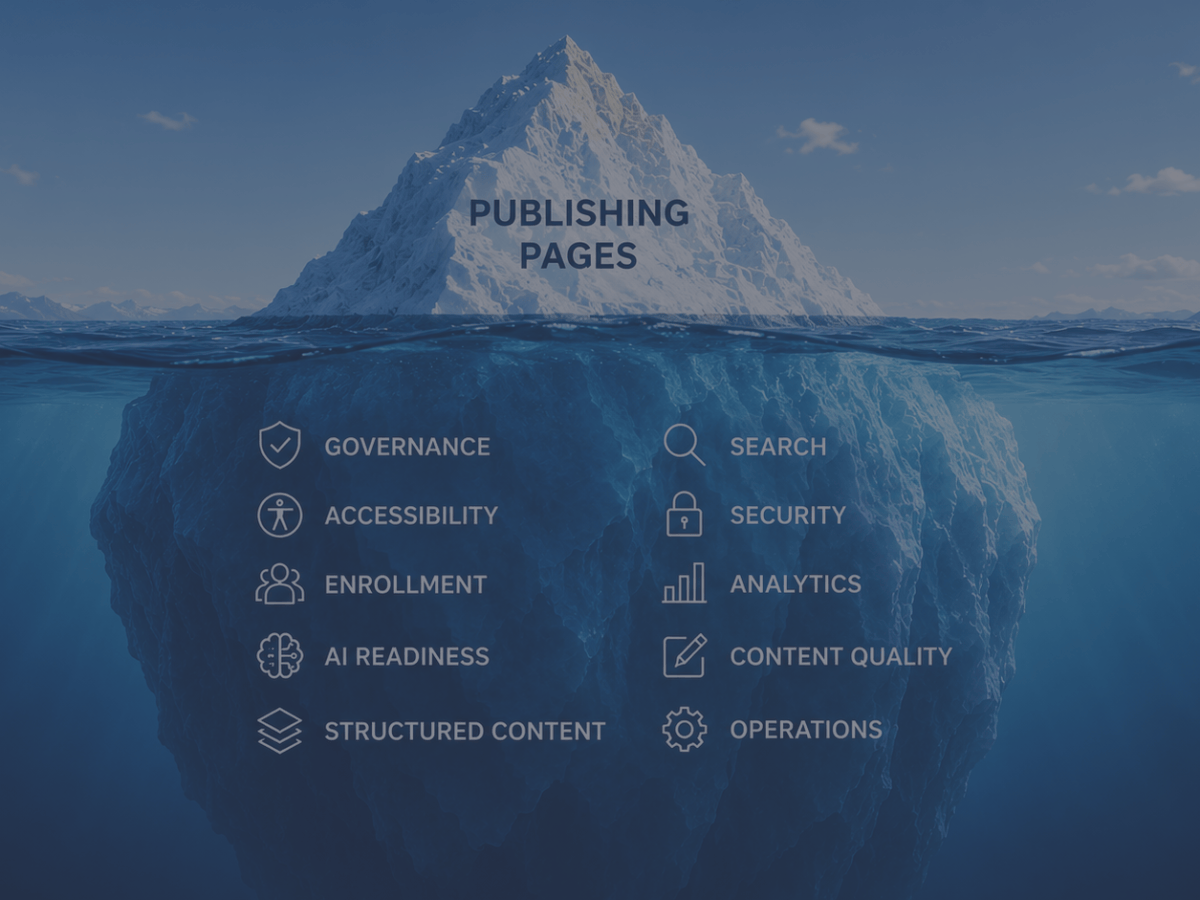
Your CMS Isn’t a Publishing Tool. It’s an Operating System.
For nearly two decades, I’ve watched higher education institutions evaluate content management systems the same way they might evaluate a word processor. Can it create pages? Can it publish content? Does it support workflows? Can multiple people edit at once? Those are valid questions, sure, but they’re also the wrong ones. A modern CMS should…

Stop asking for Web Governance – Talk about Outcomes
I use this analogy often when it comes to technology: Nobody buys a treadmill because they want a treadmill. They buy it because they want to lose weight, feel better, or increase their energy level so they can keep up with their kids. The treadmill is the mechanism, but the outcome is the point. Web…

“Just”: The Most Expensive Word in Business
There is a small, four-letter word that tends to create rather massive problems inside organizations. It shows up in emails, meetings, and casual conversations, often masking enormous complexity with a dangerous illusion of simplicity. That word is “just.” You hear it all the time, in various forms: “Can you just update the website?” “Let’s just…

Why Higher Ed Websites Keep Making the Same Mistakes
I’ve spent the better part of two decades building software for higher education web teams. In that time, I’ve watched the web evolve dramatically, from static brochureware to dynamic, personalized experiences, from desktop-first to mobile-first, from SEO to AI-driven search. Technology has changed enormously. Many of the mistakes, on the other hand, haven’t. Across hundreds…

What Customer Longevity Actually Requires
Retention metrics are easy to track. Renewal rates, churn percentages, and average contract lengths sit prominently on every dashboard. What we talk about far less is why they actually do. I have spent a long time running a software company that serves higher education institutions. Many of our customers have been with us for ten,…

Why Doing Some Things Manually Is Actually Good for You
Efficiency is important, no question about it. Whenever possible, we want to automate things though syncing, auto-filling, and having AI “handle it.” I completely understand the appeal. I use AI every day, and I’m excited about what it can do. It saves time, reduces busywork, and helps us move faster. But I’ve also noticed something…

Why AI is making exceptional work harder to achieve
AI tools have dramatically raised the floor of professional output. A mediocre writer can now produce a decent first draft within seconds. A junior analyst can generate something that resembles a competent data summary without breaking a sweat. A small team of any type can produce in a single week what used to take an…

If you spend an hour “protecting your time,” are you actually protecting your time?
We’ve all bought into the idea that we need to protect our time: Block your calendar, decline meetings, and guard your schedule like it’s a scarce resource. It sounds smart, disciplined, and productive. We read endless articles about time blocking, the Pomodoro technique, and the power of saying no. But let’s be honest: If you…

AI-powered content audits: What’s possible and what’s not (yet)
If you’ve ever undertaken a full website content audit, you know the pain: pages upon pages of outdated, redundant, inconsistent, and sometimes irrelevant or misdirected content. But with small teams, limited time, and growing pressure to deliver better digital experiences, many organizations struggle to make content audits a regular practice. Not surprisingly, web teams are…

Adaptability Isn’t Optional: Why Great Teams Flex
If there is one trait you’d want on every team, it is not just raw intelligence, years of experience, or even out-of-the-box creativity. It is adaptability. You can build the strongest strategy in your industry. You can map out a crystal-clear roadmap. You can plan for every contingency you can imagine. But reality will eventually…

Venting Isn’t Harmless: How to Redirect It Before It Damages Your Culture
In an earlier post, I talked about why venting isn’t just blowing off steam. It is a behavior that drains accountability, fuels drama, and slowly but surely eats away at your organizational culture. But knowing venting is a problem isn’t enough. The real question is: what do you do in the moment when it shows…

Best Practices Are Overrated
The longer I work in technology and leadership, the more suspicious I become of the phrase “best practices.” Don’t get me wrong. Standards are necessary. My suspicion comes from how the term has evolved. “Best practice” has become one of the most overused phrases in professional life. It sounds incredibly smart while doing very little…

7 GPTs to help higher ed make better content decisions
If you work on a higher ed website, you’ve likely tried using AI to speed up content creation. You paste in a prompt. The AI generates a page in seconds. It sounds polished, even impressive at first glance. But then you read it more closely, and something doesn’t quite work. It’s not that the writing…

When Empathy Becomes Enabling
Empathy is widely regarded as one of the most critical leadership traits of our time. And, undoubtedly, that is fundamentally a good thing. We have moved away from the stoic, unfeeling management styles of the past toward a model that values the human being behind the employee ID. We want leaders who understand stress, who…
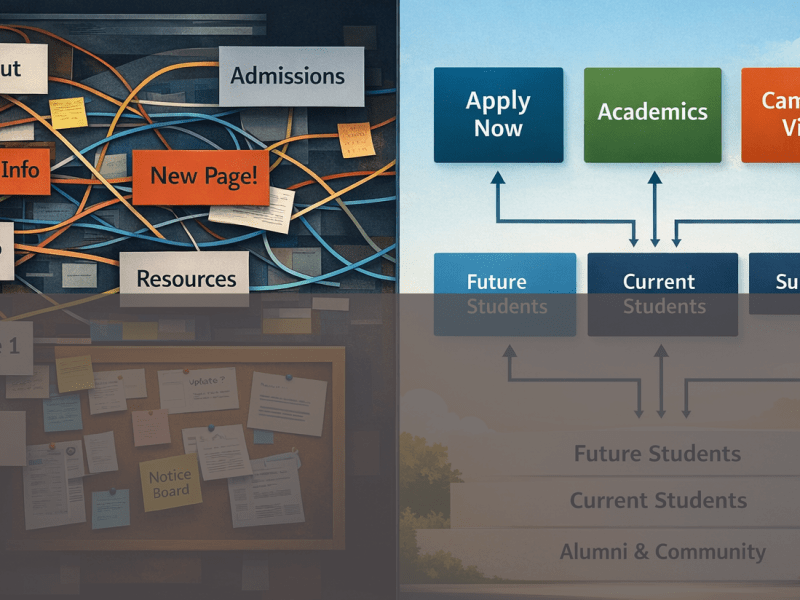
The Future of Higher Ed Websites: Harder Choices, Fewer Pages, Better Outcomes
For the last two decades, the solution to every digital problem in higher education seemed to be “more.” More pages to satisfy a department chair, more navigation items to ensure everyone feels included, more microsites for every new initiative, and more “just in case” content, archived deep within the subdirectories of a Content Management System…

When Collaboration Becomes Poor Decision-Making
We all want to work in a collaborative culture. The idea itself sounds unquestionably good, doesn’t it? We picture teams where everyone feels heard. We imagine a seamless flow of ideas from diverse perspectives. We want alignment, buy-in, and the comforting glory of shared purpose. In theory, collaboration is the secret sauce that transforms a…
Something went wrong. Please refresh the page and/or try again.

