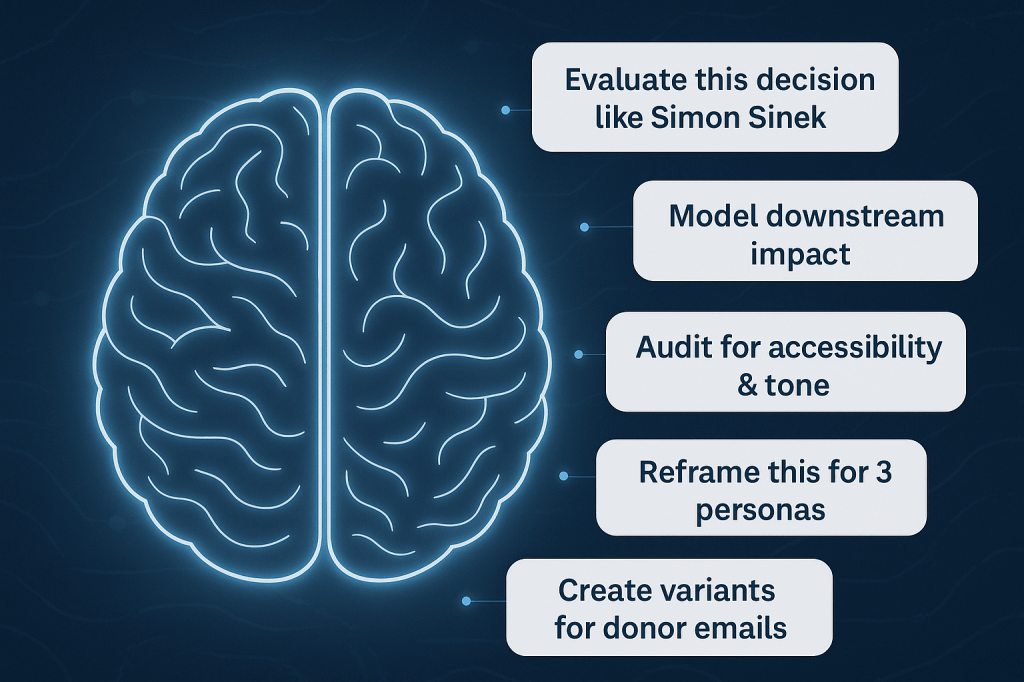
AI tools are evolving rapidly, but the real revolution isn’t just in smarter algorithms. It’s in how we prompt, guide, and collaborate with these systems. If the prompts of 2023 were “write my blog post” or “summarize this article,” the prompts of 2026 will reshape what it means to think, decide, and work.
Let’s look at some next generation AI prompts, why they matter, and how you can build this power skill to stay ahead.
The shift from simple commands to strategic collaboration
Ask anyone who used ChatGPT or other LLM-powered tools in 2023, and you’ll hear the same story. AI made everything a little bit easier and a lot faster. With one command, you can have AI write an email or social post, create a checklist or edit your content.
But as AI becomes central to every knowledge worker’s toolkit, prompts will become less about one-off tasks and more about nuanced collaboration. Your AI assistant is moving beyond “do this” to “think with me.”
This shift is significant, because in the coming years, those who master strategic prompting will set the standards for efficiency, insight, and impact in the workplace. It’s a difference as fundamental as learning Google search in the 2000s or project management basics in the 2010s.
What makes a next generation AI prompting different
Great prompts in 2026 won’t just be clear and specific. They’ll embody a new kind of leadership:
- Context-rich and goal-oriented
The best prompts give the AI backstory, constraints, and a desired end result.
- Intellectual integration
You’ll blend expert opinions, critique decisions, and ask AI to serve as a challenger or thinking partner and not just a content generator.
- Multi-format and multi-step
Modern prompts will expect the AI to analyze, summarize, synthesize, and output results for different stakeholders and channels at once.
- Bias-awareness and inclusivity
Instead of simply generating content, top prompts instruct AI to screen for accessibility, conscientious language, and systemic impacts.
- Consequential foresight
The leading edge of prompts will model downstream effects and surface scenarios leaders need to plan for.
Prompt engineering will be a core skill
Prompting is no longer about getting decent results out of a clunky tool. It has become a core operating skill for strategists, analysts, marketers, product leaders, and executives. Those who learn the new prompt language will get more out of their AI partners and spend less time bridging gaps between what they want and what AI delivers.
Next generation AI prompt examples
Here are examples and use cases that showcase what prompting mastery will look like by 2026. Adapt and experiment with these to boost your own workflows.
Rethink decision-making with a strategic partner
Prompt:
Act as my strategic thinking partner. Here’s what I’m stuck on…
Use case example: “Act as my strategic partner. I’m trying to decide whether to invest more in international student recruitment or in expanding adult learner programs. Here’s what I know so far…”
AI is no longer a passive assistant. By inviting it in as a strategic partner, you unlock cross-checks, scenario planning, and perspective-broadening dialogue. This is especially powerful in complex decisions where human bias or bandwidth might limit analysis.
Synthesize leading thinkers and frameworks
Prompt:
Combine the perspectives of [Author A] and [Author B] to critique this idea.
Use case example: “Evaluate our plan to restructure team check-ins from weekly all-hands to asynchronous updates, using the leadership frameworks of Cy Wakeman and Simon Sinek. What strengths, risks, and cultural impacts should we anticipate?”
This prompt pits efficiency and accountability (Wakeman) against connection and inspiration (Sinek), which is a common tension in remote and hybrid leadership. It forces AI to weigh emotional truth vs. emotional management, and productivity vs. purpose.
Engineer persuasive content with behavioral insight
Prompt:
Analyze this content for psychological triggers, then rewrite it to resonate with [audience persona].
Use case example: “Review this alumni donation page. What psychological levers are being used? How could this better resonate with first-gen students from rural areas?”
Personalized, high-impact content becomes standard, not a luxury reserved for big brands. The best prompts look beyond surface-level edits to shape content for real emotional effect.
Summarize, reformat, and distribute
Prompt:
Turn this 2-hour meeting transcript into 5 action items, 3 questions for leadership, and a Slack post summary.
Use case example: “Here’s a Zoom transcript of our design sprint. Give me a TLDR, stakeholder-specific summaries, and a timeline.”
Why it matters:
AI becomes the go-to tool for knowledge distribution. You get actionable summaries and communication-ready outputs in minutes, saving leaders and teams hours each week.
Personalize communication at scale
Prompt:
Create multiple message variants based on this user’s behavioral data and communication style.
Use case example: “Using Clive campaign data, generate 3 re-engagement email variants that match a warm but efficient tone. Target parents who clicked the financial aid link but didn’t convert.”
AI-powered personalization shifts from nice-to-have to standard operating procedure, equipping teams to address micro-segments and individuals with far greater relevance.
Audit for values, ethics, and inclusion
Prompt:
Audit this content for accessibility, inclusivity, and ethical phrasing.
Use case example: “Scan this chatbot script for bias, stereotype triggers, and readability below a 9th-grade level.”
With increasing regulatory pressure and cultural expectations, prompts that screen content for bias, accessibility, and inclusive language become non-negotiable. These help protect brands and empower more equitable engagement.
Anticipate outcomes and design responsibly
Prompt:
Help me think through the downstream consequences of this product feature.
Use case example: “We’re launching an AI-powered tutor to help students with writing assignments. What are the second- and third-order effects? What should we prepare for?”
The skill of prompt engineering extends into systemic thinking. You’ll use AI to challenge your vision, anticipate unintended effects, and identify risks early.
Benefits of next-level prompting
Adopting these advanced prompting techniques leads to:
- Faster, more relevant decision cycles: Actionable insights and summaries delivered in the moment.
- Consistency and inclusivity: Communication that meets ethical standards and resonates with diverse audiences.
- Personalization at scale: Content and outreach that meet users where they are.
- Operational efficiency: Multi-step summaries, reformats, and distribution handled in minutes.
- Foresight and risk management: Better anticipation of systemic impacts and ethical considerations.
Prompt engineering can be the key to more intentional, resilient, and creative teams.
Leading in the age of AI-native work
Prompting is no longer about wringing results out of black boxes. It’s about leading strategic, creative, and responsible collaboration between human and machine.
If your prompts still sound like “write an email,” now is the time to level up. The future belongs to those who know how to ask better questions, challenge assumptions, and guide AI as a true thinking partner. Start practicing these prompts today, and position yourself (and your organization) to stand out in the next AI-powered chapter of work.
What about you? What are your best examples of next-gen prompts?

 lead up
Leave a comment