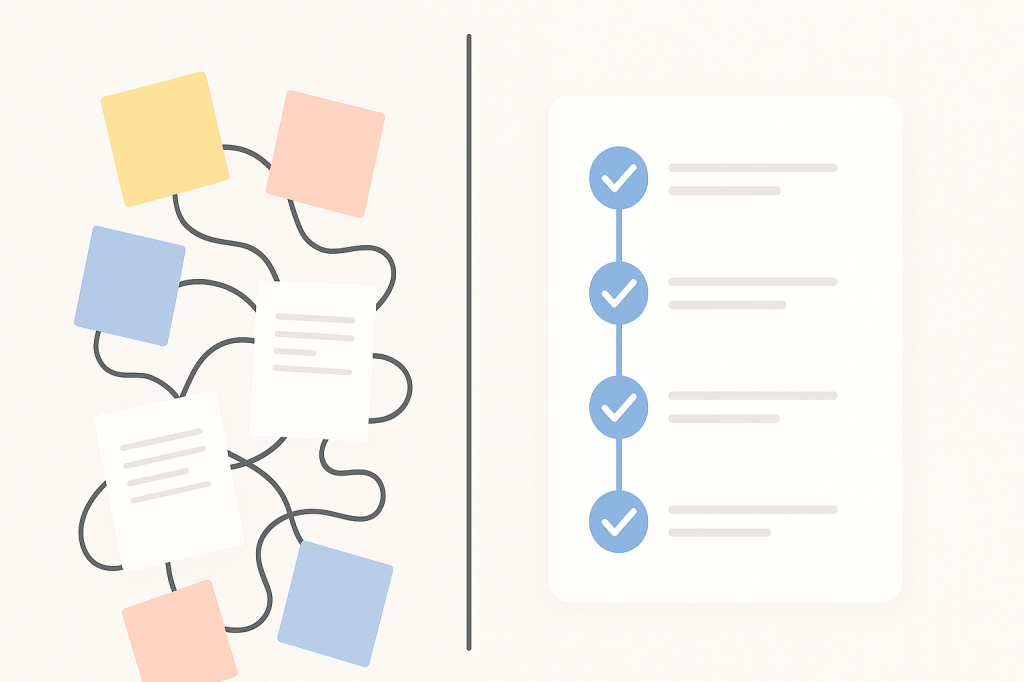
Leaders rarely waste time because they are disorganized or unmotivated. They waste time because they operate on outdated assumptions. They find themselves managing drama, re-explaining expectations, reacting to unclear priorities, and drowning in meetings that exist solely to compensate for broken processes. This is a reality-based approach to modern leadership.
As author Cy Wakeman says, “Suffering is optional.” The drama, confusion, and rework that fill your day are not the job. They’re noise around the job. For the first time in decades, we have a powerful way to eliminate that noise: AI. Not as a shiny object or a replacement for real leadership, but as a catalyst for clarity. It’s a way to remove the friction that steals your time, focus, and energy.
Let’s look at some of the biggest time-wasters for leaders, and how we can use AI to turn those chronic stressors into more streamlined workflows, so that we can focus on what matters most.
The five ways leaders waste time
Leadership roles have quietly ballooned into something unsustainable. Leaders are expected to be strategists, therapists, technical experts, project managers, communicators, and culture-shapers, all at once. When we break it down, most of the drains on a leader’s time fall into five patterns.
1. Solving the wrong problems
Many leaders spend their days firefighting symptoms instead of addressing root causes. They fix last-minute crises, rewrite team content, chase missing updates, and build one workaround after another. This might feel productive, but it’s a trap.
The real issue often isn’t the circumstance but how we think about it. Leaders frequently jump into action without first stepping back to ask: What problem actually needs solving here? AI can help you get clean data quickly, summarize what’s going on, and surface the root causes instead of just the symptoms.
2. Reclarifying expectations again and again
This one issue costs teams hundreds of hours every year. You explain a process. Then you explain it again. Then you find yourself explaining it once more in Slack, in meetings, and in follow-up emails. The lack of clear documentation is arguably one of the biggest causes of time wasting.
Ambiguity is a petri dish for drama. Clarity, on the other hand, sanitizes it. When expectations are fuzzy, team members fill in the gaps with their own stories and assumptions, leading to rework and frustration.
3. Managing emotions and drama
Leadership requires a high degree of emotional intelligence. However, there is a difference between productive emotional support and unnecessary emotional labor. Time spent navigating venting, spiraling conversations, and conflict triangulation is time stolen from high-impact work.
Drama is essentially emotional waste. It consists of the stories, assumptions, and narratives that steal focus from reality. While AI cannot fix human emotions, it can reduce the ambiguity and miscommunication that often spark drama in the first place.
4. Meetings that should have been a workflow
A shocking percentage of meetings exist simply to get updates, restate decisions, clarify next steps, or piece together scattered information.
When work is clear and processes are documented, the need for these kinds of meetings shrinks dramatically. Meetings can become what they are meant to be: forums for strategic discussion and collaborative problem-solving, not therapy sessions or complaint centers.
5. Delayed decisions
Leaders sometimes stall important decisions because they feel responsible for having perfect information. This drive for perfection leads to collecting more data, getting more input, or rewriting a message “just one more time.” This pursuit of certainty slows everything and everyone down.
Your circumstances are not the reason you cannot succeed. It’s your thinking about your circumstances. AI can support leaders with drafts, scenarios, and data-driven clarity so they feel confident making decisions sooner.
How AI fixes the time-wasting problem
It is here to remove friction so humans can lead with clarity, courage, and accountability. Here are some ways in which the right application of AI can transform leadership.
AI creates clean data and decisions
Leaders spend an enormous amount of time cleaning up information. AI can take on this burden by summarizing complex discussions, turning messy notes into clear documentation, and extracting decisions and next steps. It can also outline risks and tradeoffs for you. As clarity goes up, rework goes down. Teams get aligned faster, and leaders stop repeating themselves.
AI as a thinking partner
Every leader needs a sounding board. With AI, you can have one instantly. You can use AI to explore scenarios, challenge your own assumptions, generate strategic options, and refine your messaging. It helps reduce overthinking and analysis paralysis because you no longer start from a blank page. You start from a structured, thoughtful draft.
AI workflow automation shrinks meeting overload
Imagine a world with fewer, better meetings. AI can make that a reality by automating or streamlining weekly updates, agenda creation, post-meeting summaries, onboarding steps, and recurring project tasks. The result is fewer meetings, more momentum, and more breathing room for actual leadership work.
AI strengthens accountability
Accountability often becomes an emotional issue (“Why didn’t this get done?”) instead of an operational one (“Here is what we agreed to, documented clearly”). AI helps leaders create checklists, documentation, clear responsibilities, and action plans. When expectations are documented and transparent, accountability becomes objective, not personal.
AI reduces emotional load
Communicating as a leader can be hard. AI can support you by drafting difficult messages in neutral, factual language. It can help you remove emotional charge, eliminate assumptions, and rewrite escalation messages with clarity and calm. This helps leaders stay grounded and model the emotional neutrality that Reality-Based Leadership encourages.
Seven steps to get started
Ready to see a change? Small shifts can compound quickly. Try this simple plan to integrate AI into your leadership practice.
Day 1: Replace one status meeting with an async update generated by AI.
Day 2: Turn one chaotic process into a clear Standard Operating Procedure (SOP) using AI to help you draft it.
Day 3: Create your “AI executive assistant” prompt to help manage your schedule, communications, and priorities.
Day 4: Identify one recurring leadership task, like drafting a weekly report, and automate it with an AI tool.
Day 5: Use AI to draft a difficult or delicate communication, focusing on neutral and factual language.
Day 6: Have AI summarize your week’s activities and help you set clear priorities for the week ahead.
Day 7: Reflect. Where did drama decrease this week? Where did clarity increase?
Prompts to try
Here are some prompts leaders can use to reduce emotional waste, eliminate friction, and lead with clarity.
Clarifying the problem
- “Here’s the situation I’m dealing with: [paste situation]. Help me identify the root cause, not just the symptoms. What problem should I actually be solving?”
- “Before I jump into action, break this down into: what’s happening, what I know for sure, what assumptions I might be making, and my next best step.”
Setting clear expectations
- “Create a clear, actionable set of expectations based on these goals and responsibilities. Make it concise, specific, and easy to understand: [paste info].”
- “Here’s a process I’ve explained verbally multiple times: [paste process]. Turn it into a clean step-by-step SOP with owners, timelines, and success criteria.”
- “Turn this Slack thread into a single-source-of-truth summary with decisions, next steps, owners, and deadlines: [paste thread].”
Reducing drama and emotional waste
- “Rewrite this message in neutral, factual, drama-free language that removes emotion, judgment, and assumptions: [paste message].”
- “Help me respond to this emotional message with calm clarity—compassionate but focused on facts and next steps: [paste message].”
- “Create a script that helps redirect someone from venting to problem-solving using Reality-Based Leadership principles.”
Eliminating meetings
- “Convert this weekly status meeting agenda into a fully async workflow with templates and update formats so the meeting becomes unnecessary.”
- “Summarize this meeting transcript into: decisions, owners, deadlines, risks, and open questions: [paste transcript].”
Accelerating decisions
- “I need to make a decision about: [topic]. Give me 3–5 options, the tradeoffs for each, and your recommendation based on the data.”
- “Draft a ‘good enough’ version of this message that is clear, concise, and ready to send with minimal edits: [paste draft].”
- “Generate a scenario analysis for these choices: [list], including risks, effort, ROI, and what happens if I delay.”
Strengthening accountability
- “Turn these notes into a clear agreement with tasks, owners, success criteria, and due dates: [paste notes].”
- “Create a RACI-style responsibility breakdown for this project based on the following info: [paste project details].”
- “Rewrite this follow-up message so it’s direct, neutral, and grounded in documented expectations: [paste message].”
Reducing overload
- “Summarize my week based on these notes and help me identify my top 5 priorities for next week: [paste notes].”
- “Help me create a customized ‘AI Executive Assistant’ prompt that supports scheduling, message drafting, priority setting, and weekly reviews. Here’s my role: [describe role].”
- “Organize these scattered notes into a clear plan with categories, deadlines, and delegated items: [paste notes].”
Reality-based leadership reminds us that the biggest cost in any organization is emotional waste. AI finally gives leaders the ability to reduce drama, increase clarity, speed up decision-making, and improve accountability. It helps eliminate expensive rework and stop the cycle of babysitting emotions. Let AI do the work that drains your time but does not require your unique talent.

 lead up
Leave a comment