desk by the window

Start with intention: Why planning your day out loud actually works

There’s a moment every morning that quietly determines how the rest of your day will go. It’s not when you open your inbox. It’s not your first meeting. It’s that moment, before the noise sets in, when you decide what kind of day you’re going to have. That’s why I’m a firm believer in starting the day with a realistic, intentional plan and in posting that plan right when your day begins, not hours into it. This isn’t about reporting in or logging hours. It’s about leading your own day with clarity, honesty, and purpose.

This post is about the power of being proactive and about starting on purpose rather than drifting into reaction mode.

Daily stand-ups still hold up

Years ago, I wrote a post called From a Hard-Core Advocate of Daily Stand-Ups, and everything in it still holds true.

Daily stand-ups work because they:

  • Force you to reflect on how the previous day went
  • Help you begin your day with focus
  • Surface blockers and competing priorities in real time
  • Create small moments of accountability that compound over time

And here’s the key: they only work if they happen at the beginning of your day. Not mid-morning or after your meetings. If your update isn’t shaping your day, it’s just commentary. Not a tool.

If live stand-ups aren’t possible, the next best thing is this:

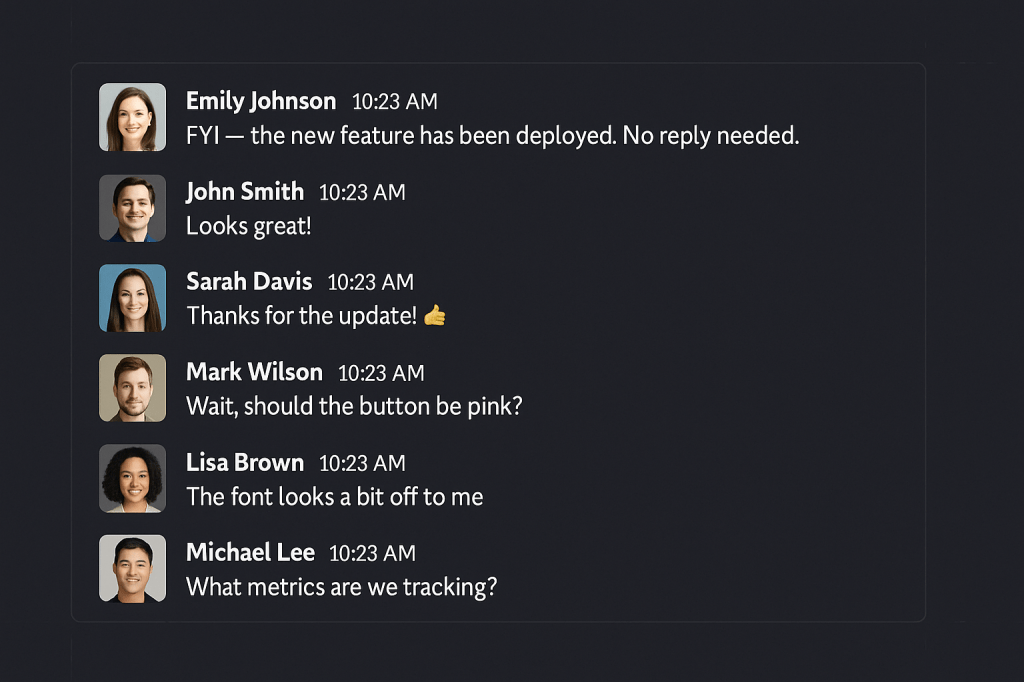
Have everyone post a short, focused update in Slack as soon as they start working.

Why it has to happen first

When you wait until later in the day to plan, your day’s already been hijacked. The meetings, messages, and fire drills have already dictated your focus.

Posting a morning update before you dive in forces intentionality, puts you in the driver’s seat, and signals to you team where you’re focused and where you may need support. 

Plan with honesty and realism

Let’s be blunt: you’re not going to accomplish 20 meaningful things in one day. So don’t write your update as if you will.

Your daily plan isn’t about documenting everything you could do. It’s about identifying what really matters today. The 2–5 high-impact priorities that deserve your time, attention, and energy.

Being honest with yourself matters here:

  • Is this task truly important or just easy to check off?
  • Is this list realistic given the meetings and energy you actually have?
  • Am I setting myself up to succeed or to feel behind?

As Greg McKeown puts it in Essentialism: “You can do anything, but not everything.”

The value of daily planning isn’t in ambition. It’s in alignment.

What a good update looks like 

Your update should be written by you, in plain English, and at the start of your day. Not by a tool. Not copied from a ticketing system. Not written in project-speak or tech jargon.

It should answer:

  1. What did I plan to do yesterday? Did I follow through? If not, why not?
  2. What am I focusing on today, and why does it matter?
  3. Is anything blocking me or shifting my focus?

Tools don’t think, but you do

Most of us use project management systems that populate our tasks automatically. And while those are helpful for visibility, they’re not your plan.

If you let a tool dictate your priorities, you’ll end up reacting to deadlines instead of leading with intention.

Writing your own update forces you to pause, prioritize, and communicate clearly, not just to others, but to yourself.

Reflect honestly and learn from the patterns

At the end of the day (or the next morning), check in with yourself:

  • Did you stick to your plan?
  • If not, what got in the way? Were your priorities realistic?
  • Did you let urgency overtake importance?

Honest reflection is what turns this from a routine into a leadership tool. When you regularly notice what’s working and what isn’t, you get better at planning, better at staying in your lane and better at protecting time for what matters.

This isn’t about micromanagement or checking boxes. It’s about building a habit of purposeful work, starting with a plan, crafted by you, in your own words, at the very beginning of your day.

And it only works if you’re honest with yourself. If you know you’re not going to get to 20 things today, don’t write down 20 things. Start early and in a truthful way. 

Because real momentum doesn’t come from doing more, it comes from doing what matters, on purpose.

ai and human shaking hands

From day one to day 90: Using ChatGPT to support onboarding and continuous learning

Why AI can transform onboarding and training

Onboarding and continuous learning are critical to building a strong, capable workforce, but they can also be time-consuming and inconsistent. New hires often feel overwhelmed due to  information overload. At the same time, managers are stretched thin trying to provide personalized support. Therefore, it’s no surprise that companies are starting to explore ways in which AI can help provide a scalable and accessible way to enhance the onboarding and training experience. This isn’t about replacing human interaction, but about making important information more consistent, approachable, and available on demand. For the purpose of this post, we will focus on ChatGPT.

Instant and personalized knowledge bases

ChatGPT can act as an always-available assistant for new hires, answering common questions about processes, policies, tools, and culture. Instead of waiting hours or days for a manager’s reply, a new team member can ask simple questions such as “How do I submit a PTO request?”, “How do I request help from IT?”, “Who needs to approve external communications before they’re published?” or “What branding guidelines should I follow when creating social media posts?”. Note that it’s easy to train custom versions of ChatGPT by feeding it internal documentation like your handbook and communication playbook, to deliver answers specifically for your company. 

Role-specific learning paths

Managers and HR teams can use ChatGPT to quickly create customized onboarding checklists or learning plans for different roles. For example, you can use a prompt like “Create a 30-day onboarding plan for a new Customer Success Manager for a SaaS company/[your company]”. You can even take it a step further by asking for key success metrics or for further details about a specific objective, for a daily planner that includes recurring meetings like stand-ups, or for a table indicating which tasks involve other team members and which ones are self-guided. 

This approach ensures that every new hire has a thoughtful, structured experience without requiring managers to reinvent the wheel every time.

Practicing scenarios and soft skills

ChatGPT can simulate real-world conversations, giving new hires a chance to practice soft skills in a safe environment. For example:

  • Handling a difficult customer interaction
  • Conducting a feedback conversation with a colleague
  • Asking questions during a discovery call
  • Conducting a Quarterly Business Review (QBR)
  • Managing a customer who missed key onboarding deadlines.

Just provide ChatGPT with instructions like “Act as a customer who…” or “Simulate a situation where…”, or “Pretend to be a user who”. These role-playing exercises help employees build confidence and prepare for real-world challenges before they encounter them.

Reinforce ongoing training

Of course, training doesn’t stop after the first 90 days. ChatGPT can also serve as an ongoing resource for you when it comes to things like

  • Quizzing employees on company values, product knowledge, security protocols, or value proposition
  • Scenario testing, where employees can walk through different case studies and challenges.
  • Microlearning sessions, allowing employees to engage in bite-sized learning at their own convenience.

Here are some examples:

After a new product release, Customer Success Managers could quiz themselves on the new features by using prompts such as “Give me 5 multiple-choice questions about [product]’s new feature rollout.” Or an Account Executive could ask ChatGPT to act as a specific buyer persona and provide feedback on how well the AE explained the value of a specific feature set. You can also use the tool to help prepare for potentially uncomfortable internal conversations. For example, you can ask ChatGPT to “Act as a teammate to whom I need to give critical feedback about their time management skills.”. Examples of microlearning opportunities are a CSM quickly refreshing their knowledge on upcoming feature names before a call with a customer, or a Support Engineer getting a summary of the last 3 releases to help explain to a customer why they should upgrade to the latest version of the product. 

Fostering a culture of continuous learning is not just beneficial for everyone, but it can also be fun. Consider creating a Slack channel where team members discuss creative uses of AI that help them in their roles. 

Support managers and team leads

ChatGPT isn’t just for new hires, but it can also be a valuable tool for the people supporting them. Managers and trainers can use AI to:

  • Get suggestions on how to improve existing training materials
  • Provide ideas for mini-”homework” assignments for each role on the team to continue to sharpen their skills (“Explain our newest feature like you’re talking to a non-technical customer”)
  • Help team members hone their communication skills (for instance, have ChatGPT generate an email from a customer who is frustrated with something specific and then assign the team member the task to respond to it)
  • Reinforce knowledge of new product features, internal tools, or SOPs by having team members quiz themselves (“Summarize the top 2 use cases for marketers and for developers when interacting with X”).

By using ChatGPT, managers can make professional growth feel more continuous and accessible, help employees practice in a safe space, and foster a culture of curiosity, all without adding heavy training costs. It also frees up time spent on repetitive tasks and frees managers up to focus more on mentorship.

These are just a few ideas on how to use ChatGPT to help with onboarding and continuous learning, making it more consistent, accessible, and effective, while allowing managers and team leads to have more time for individual coaching. By combining the best of human guidance with the capabilities of AI, organizations can create a better experience for everyone involved.

What about you? What are your ideas for using ChatGPT for onboarding and ongoing training?

dark cloud

When it’s been a tough week: honesty or spin?

We’ve all had them, those weeks that knock the wind out of you. A missed opportunity, an unexpected client loss, a launch gone sideways, a painful conflict. Whatever the cause, there are times when work feels heavier than usual. In those weeks, the pressure to spin positivity is real. I try not to.

Not because I believe in wallowing, or in dragging the team down by being a Debbie Downer. But because honesty is far more valuable and powerful than pretending things are better than they are.

Lessons are hiding in the hard weeks

Hard weeks don’t just hurt, they can also be learning opportunities. They illuminate blind spots, reveal what’s not working, and force clarity around what matters most, but only if we’re willing to face them directly.

As leadership expert Brené Brown puts it: “Clear is kind. Unclear is unkind.” – Brené Brown, Dare to Lead

Being honest about a loss or a failure isn’t a weakness. It’s a commitment to learning. It’s saying: This didn’t go as planned. Let’s understand why so we can do better next time.

Simon Sinek reminds us: “The most effective leaders are the ones who can tell the truth, even when it’s hard, because that truth clears a path to progress.”

Lead with honesty and resilience 

Being honest doesn’t mean being dramatic or dwelling in negativity. It means acknowledging what’s hard, owning the impact, and offering a way forward.

You can say: “This was a really tough week. We didn’t hit the mark. But here’s what I’m doing to get us back on track and here’s how you can help.”

That kind of leadership invites ownership and builds a sense of safety. It tells your team that we can handle this together. Learning how to develop resilience in the face of adversity is one of the best gifts you can give your team and yourself. It also helps us focus on the most important things rather than engaging in discussions or activities that are not moving the needle.

Trust your team to rise to the occasion

Your team doesn’t need you to be endlessly upbeat. They need you to be transparent. When people understand what’s at stake, most will step up if they’re given the chance. But if they’re led to believe everything is fine, they’ll either be caught off guard later or continue under false assumptions.

That’s not just inefficient, but downright unfair.

Don’t hide the hard stuff, but instead be clear, candid, and real. Not just because it’s the right thing to do, but because it builds a culture of trust, growth, and accountability.

Some weeks are tough. Losses are tough. But they’re not the end if you don’t let them be wasted. They’re often the beginning of the next chapter if we let them teach us.

What about you? How do handle communication when it’s been a rough week or two?

customer communication involves all departments

There’s no such thing as over-communicating when it comes to your customers

If there’s one thing I’ve been saying at nauseam in internal conversations: There’s no such thing as over- communicating when it comes to your customers.

We’ve all experienced first hand how some organizations treat customer communication like a one-lane road, owned and operated solely by the customer success or support team. But the truth is, our customers don’t experience our companies in silos at all, so why shouldn’t operate that way? When you open up communication across teams and create visibility into what customers are experiencing and sharing, you can build a culture that’s not just customer-friendly, but customer-obsessed, which is a much better place to be in.

Here’s why I think it matters, and how you can start fostering a that culture.

Create a dedicated Slack channel

Nobody wants more meetings, so you can start with a cross-functional Slack channel for customer insights. This can be your internal hub for things like:

  • Good news: big wins, unsolicited praise, successful launches
  • Red flags: early signs of dissatisfaction, usage drops, missed expectations
  • Complaints: even if they’re tough to hear. You need to share what’s really going on without sugarcoating.
  • Challenges and blockers: recurring issues, misalignments, confusing parts of your product
  • Aha moments: when a customer uses your product in a brilliant, creative, or unexpected way

Don’t restrict access to the channel. Invite Sales, Product, Services, Marketing, and Leadership, and really anyone who touches or impacts the customer experience. You might be surprised by the insights that come from someone who isn’t a Customer Success Manager. A marketer may have seen a trend. A developer might immediately understand the root cause of an issue that the customer is reporting. An account executive might chime in with helpful background from the buying journey. If you’re worried about overloading your team with messages, just make it clear that not everything requires an acknowledgement, let alone a response. 

Make customers a part of the weekly conversation

Sharing updates in Slack is a good start, but not everyone looks at those updates all the time, and you don’t want to miss the opportunity to drive change. Make some space in your weekly company updates or all-hands meetings for a quick customer snapshot. It doesn’t need to be a full write-up or polished presentation, just a few minutes to surface recurring themes, such as

  • Are multiple customers asking for the same functionality?
  • Did a recent update excite users or confuse them?
  • Are there usage patterns indicating onboarding gaps?
  • Were customers not aware of a newly implemented feature or a service that you offer?

These patterns should inform roadmap conversations, onboarding optimization, and sometimes even hiring.

In addition, encourage your team to stay informed and curious about what’s going on in your customers’ world that may not have anything to do with your product or service. We share at least three articles about our customers every week in our weekly updates, because it makes us appreciate everything that our customers do and how they make the world a better place.

Break down the walls between roles

One of the most impactful things you can do is give everyone the opportunity to interact with customers, especially when they can add unique value. For example, let your engineers sit in on customer success calls. Encourage your marketers to attend quarterly business reviews. Invite your product leaders to join customer onboarding calls. Empower your sales reps to loop in implementation developers earlier in the sales process (if they have the bandwidth, of course).

The point is not to flood your customers with too many touchpoints, but to bring more clarity, more empathy, and more value to every interaction. When customer knowledge lives in silos, things tend to fall through the cracks, issues get repeated, feedback loops can break down, and your teams make assumptions based on partial or outdated information.

But when customer communication is shared, celebrated, and acted on:

  • Product decisions feel less speculative
  • Marketing becomes more relevant
  • Support becomes more proactive
  • The team starts speaking the customer’s language
  • Empathy grows

You can create alignment not just on what you’re building, but who you’re building it for. Make everyone listen to your customers. Because when your whole company becomes part of the customer conversation, you build stronger relationships, better products, and a clearer sense of purpose.

What about you? How much communication about your customers is too much?

tightrope walker

Balancing political neutrality with business reality

Most of us follow an unspoken (or sometimes very much spoken!) rule in the workplace: stay politically neutral. Don’t stir the pot, don’t alienate, and simply don’t “go there.” In a professional setting, neutrality often feels like the most respectful and inclusive choice. After all, we’re here to do the work, not debate federal or state policies or political philosophies. But when politics and policies start directly impacting your employees, your customers, or your ability to do business, silence can feel less like neutrality and more like avoidance. So how can you mitigate the tension?

Here are a few thoughts:

Neutrality doesn’t mean numbness or ignorance

Being politically neutral in a professional setting doesn’t mean we stop caring. It doesn’t mean we avoid hard topics or pretend they don’t exist. It means we don’t turn our platforms into partisan battlegrounds. But we can, and should, acknowledge reality, especially when it’s affecting the people we work with or serve.

If your team is impacted by immigration policy changes, if your clients are in a state where access to education or healthcare is shifting, or if legislation affects your ability to hire talent, you don’t need to pick a party to speak up. You just need to focus on your people.

When deciding whether to address something political, ask yourself: Does this issue intersect with your mission, your team members, or your work in a real way? If the answer is yes, you know that it’s a business issue, not a political one. And treating it like one doesn’t make you biased. It makes you responsible. You’re not weighing in for the sake of commentary, but you’re staying aligned with our values and helping the people who make your work possible.

Example: Higher ed and shifting immigration policies

As someone who works closely with colleges and universities, I’ve seen firsthand how federal or state-level policies directly affect our clients’ ability to do their jobs. Take international student enrollment, for example. When visa rules change or when public discourse creates a perception that international students aren’t welcome, institutions are put in a tough spot. Their budgets are affected. Their student services teams are strained. Their reputation may even take a hit. And, perhaps most importantly, they’re trying to support students who might feel unsure, unsafe, or unwanted.

If we, as a partner, ignore that or stay silent out of fear of “being political”, we’re missing the point. It’s not about politics. It’s about people. And it’s about understanding the real-world context in which our customers operate, so we can better serve and support them.

Clear and careful communication

Let’s say you decide to speak up about a certain issue or development. Keep in mind that it is not a performance or getting on a soapbox. It’s about being clear, sincere, and grounded in real impact.

You don’t need a press release or chime in on every headline. But if a policy or political shift is directly affecting your team or your clients, say so. Be specific. For example, if new visa restrictions are making it harder for your university clients to support international students, acknowledge that and share helpful resources. You don’t have to issue sweeping statements, and you’re definitely not expected to solve the issue. But you can acknowledge it, share how it impacts your company, and outline what you’re doing in response.

Not everything requires a response

There’s a big difference between being silent and being thoughtful about when and how you engage. And it is perfectly fine to take some time for reflection or to refrain from jumping into the discourse every chance you get. You don’t have to issue grand statements, and you don’t have to take sides. 

What you do need to do is stay informed about what is going on in the world and develop a deep understanding of how it affects your company and your customers, so that you can lead with intention. 

Always keep in mind that it’s not about taking sides, but about being focused on your team members and your clients. 

What about you? How do you navigate situations when politics impact your company?