Brain connected to legal, finance, and HR

9 powerful ways legal, finance, and HR can use AI

When you think of AI at work, it’s easy to picture marketers drafting blog posts or crafting social media content. But AI’s possibilities go beyond marketing. In fact, some of the most revolutionary uses of AI are happening in traditionally less front-facing roles such as legal, finance, and HR.

These departments are the backbone of any organization, handling complex tasks that require precision, analysis, and judgment. AI’s capabilities in these areas can save countless hours, minimize errors, and help teams make decisions more efficiently.

Let’s explore nine ways in which legal, finance, and HR departments can take advantage of the power of AI to transform their workflows.

Legal: AI tools for efficiency and precision

Streamline contract summaries

Contracts are often long, dense, and packed with legal jargon, but AI can simplify this process. Tools powered by AI can summarize contracts into plain English, highlight unusual clauses, and flag high-risk terms. Want to compare contract versions? Ask an AI tool to identify key changes, saving paralegals and attorneys hours of tedious work.

Example prompt:

“Compare these two versions of the vendor agreement and highlight differences in termination clauses.”

Draft policies 

Writing legal policies, such as Acceptable Use Policies or Non-Disclosure Agreements, is time-consuming. AI can take your specific requirements and generate a solid first draft, which you can refine for tone and compliance.

Example prompt:

“Write a GDPR-compliant NDA in a friendly but professional tone.”

Translate legal documents

Whether expanding globally or dealing with international clients, language barriers can be an issue. AI-enabled language tools can translate policies and contracts efficiently, saving you days of waiting on manual translations.

Finance: AI simplifying reports and forecasting

Automate monthly reports

Every finance professional knows the struggle of analyzing and retrieving insights out of spreadsheet data. AI simplifies this process by turning numbers into concise, actionable written summaries. With just a few keystrokes, your month-end report can be ready.

Example prompt:

“Summarize the revenue and expense data in this spreadsheet. Highlight any anomalies.”

Spot financial anomalies

AI-powered tools are great at analyzing complex datasets to flag duplicate entries, high-value transactions missing documentation, or irregular patterns in spending. For auditors and accountants, this acts as an efficient second pair of eyes.

Example prompt:

“Identify transactions over $3,000 in this expense report that don’t have a matching purchase order.”

Pro tip: You can even upload your expense policy and a screenshot of a receipt and ask AI to see if the two are compatible. 

Create cash flow forecasts

Analyzing financial projections takes time and expertise, but AI can run the numbers and generate forecast summaries with assumptions clearly outlined.

Example prompt:

“Use the given revenue and expense projections to create a three-month cash flow report.”

HR: AI enhancing recruiting and employee retention

Craft effective job descriptions

Recruiting top talent often starts with an engaging job post. AI can write job listings tailored to specific roles, company culture, and diversity goals, saving recruiters time and improving hiring outcomes.

Example prompt:

“Create a job description for a remote junior software engineer focusing on growth opportunities.”

Develop targeted interview questions

AI supports HR professionals by crafting custom interview questions. Whether you need questions for specific roles or particular skills, AI helps focus the conversation where it matters most.

Example prompt:

“Generate five behavioral interview questions for a project manager emphasizing leadership and adaptability.”

Another pro tip: Upload the job description and a candidate’s resume and have AI spot where the candidate’s skills align and where there could potentially be gaps. It’s still up to you to dig deeper during the interview (don’t outsource your interviewing and people skills), but this can give you some things to think about. 

Summarize employee feedback

Employee satisfaction surveys and performance reviews often include valuable insights, but parsing through endless responses can be overwhelming. AI tools can identify recurring themes and summarize findings, providing actionable insights in minutes.

Example prompt:

“Summarize strengths and challenges mentioned in these employee reviews.”

Create personalized onboarding plans

Effective onboarding is key to retention. AI can help HR teams design tailored onboarding programs by factoring in the employee’s role, location, and team structure. Here’s a more in-depth post on this subject.. 

Example prompt:

“Design a 30-day onboarding plan for a Customer Success Manager  that includes training, shadowing, and performance check-ins.”

Risks and pitfalls to consider while using AI

While AI offers game-changing potential, it’s not without its challenges. Here are some key risks to keep in mind when integrating AI into your business functions.

Hallucinations and errors

AI can sometimes provide inaccurate or overly confident responses, particularly in legal, financial, or compliance scenarios. Always double-check AI-generated outputs to ensure accuracy.

Loss of context

AI tools need precise, well-organized data to deliver meaningful results. Vague or overly general prompts can produce irrelevant or misleading results.

Be detailed in your instructions, and ensure all necessary context is provided.

Data privacy concerns

Many AI tools rely on cloud-based systems, meaning any data you input is stored or processed externally. Avoid pasting sensitive information into tools without clear data privacy policies, or consider enterprise-grade AI solutions with stronger security measures.

Potential bias

AI tools trained on public datasets may unintentionally replicate biases present in the data. Use tools designed for fairness to eliminate potential bias in job descriptions, performance reviews, or customer-facing policies.

Wrap-up

Automation technology like AI doesn’t aim to replace professionals. Rather, it acts as an invaluable assistant. Think of AI as your fastest, most focused assistant, quick to get things moving but still reliant on your expertise for the best results.

By leveraging AI, you can drastically cut down on repetitive tasks, streamline complexity, and empower your team to focus on high-impact work. Transforming departments like legal, finance, and HR has never been easier, or more essential, in staying ahead in today’s fast-paced business world.

What about you? What are your favorite use cases of AI in “the back office”?

cooking ingredients, knife, cutting board, pot

Get better results from AI with prompt layering

When people first start using AI tools like ChatGPT, they usually ask questions in one shot and hope for the best. Sometimes that works, but oftentimes, the output is not as wonderful as expected. Too generic, too long, or missing the mark entirely. And then they give up, which is one of the biggest mistakes you can make with AI. 

Getting great results from AI isn’t about asking the perfect question. It’s about layering prompts strategically to build toward exactly what you need without going down a rabbit hole of endless rewrites.

Many professionals spend hours tweaking massive prompts or repeatedly starting over because their initial request didn’t capture their vision. This approach wastes time and often leads to frustration. There’s a better way.

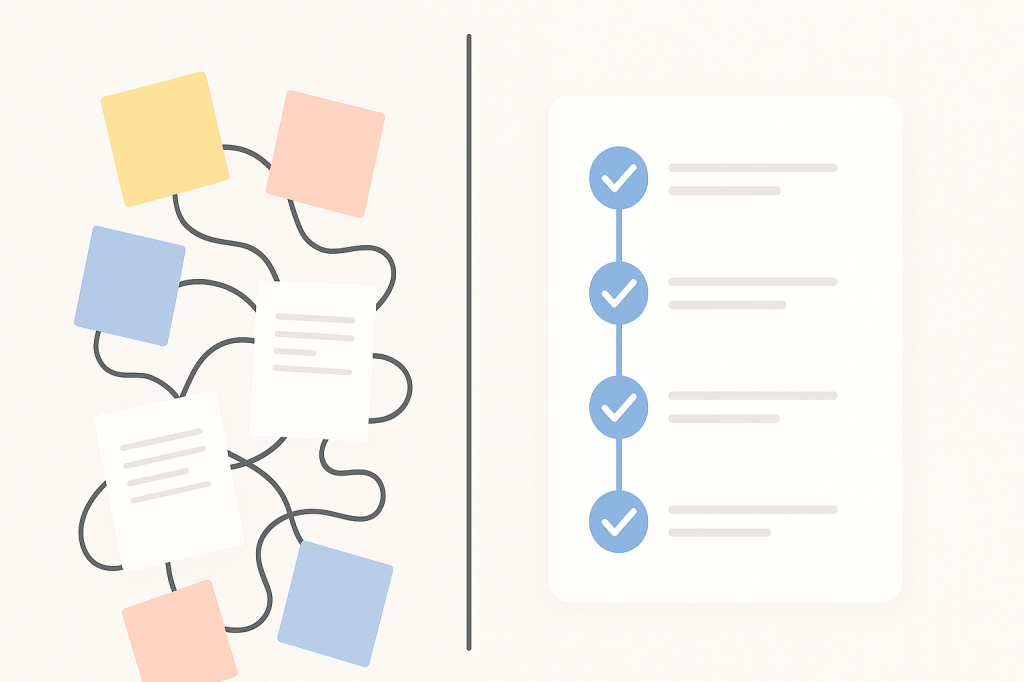
Prompt layering transforms your AI interactions from guesswork into a more systematic process. It’s a method that helps you guide AI tools step by step, refining output incrementally rather than hoping for perfection on the first try.

What is prompt layering?

Think of prompt layering as having a conversation with your AI tool rather than issuing a single command. Instead of trying to cram every detail into one mega-prompt, you stack smaller, purposeful instructions.

Each layer refines the output by narrowing focus, improving clarity, or adjusting style until you arrive at something polished and usable.

It’s a bit like cooking:

  • The first layer is getting all your ingredients lined up.
  • The second is preparing them.
  • The third is seasoning to taste.

By the end, you’ve created a meal instead of tossing everything into the pot at once.

This approach recognizes that AI tools work best when given clear, sequential guidance rather than complex, multi-faceted instructions all at once. Treat AI like a new team member! You wouldn’t expect a new person to give you the perfect deliverable on the first try, right?

Why it works 

Clarity compounds: Breaking a complex request into layers gives the AI room to think step by step, which typically produces sharper results. Each layer builds on the previos one, thus creating a clearer picture of what you want.

Faster iteration: Instead of rewriting long prompts from scratch, you tweak in small steps. This saves time and avoids the frustration of losing perfectly good elements when making changes (we’ve all been there!).

Creative control: Layering lets you guide the AI output more like an editor than a passive recipient. You maintain control over the direction while optimizing AI’s capabilities.

Reduced cognitive load: Rather than trying to anticipate every requirement upfront, you can respond to what you see and adjust accordingly. This mirrors how humans naturally work through complex solutions and is also reminiscent of the agile developement approach.

The 3 core layers

Here’s a simple framework you can apply to almost any task:

1. Rough draft 

Start broad. Give the AI a clear but simple request.

Example: “Write a blog intro about why personalization matters in higher ed websites.”

This gets something on the page quickly. Don’t worry about perfection here. You’re establishing the foundation and giving yourself material to work with.

The key is to be specific enough that the AI understands the topic but general enough that you’re not overwhelming it with requirements.

2. Refinement 

Now you add precision. Tell the AI what’s missing, what tone to use, or what format you need.

Example: “Make it more conversational and add a quick metaphor that compares personalization to a campus tour guide.”

This is where you shape the content closer to your voice and vision. You’re working with existing material, which is much more efficient than starting over.

Focus on one or two key improvements per refinement layer. This keeps the AI focused and prevents confusion.

3. Optimization

Finally, you polish for your specific purpose. Ask for variations, summaries, or format adjustments.

Example: “Shorten this to under 150 words and include the phrase ‘higher education marketing.'”

This last step makes the output immediately usable for your specific context and requirements.

As Antoine de Saint-Exupéry once said, “Perfection is achieved not when there is nothing more to add, but when there is nothing left to take away.” That’s exactly what the optimization layer is about: removing the excess and sharpening what matters until the result is clear, concise, and ready to use.

Advanced strategies

Shifting perspective: After getting your initial output, ask the AI to rewrite from a different perspective or for a different audience. This often reveals new angles you hadn’t considered.

Flipping the format: Take your content and ask for it in different formats such as bullet points, numbered lists, or narrative form. This helps you find the most effective presentation.

Stacking speficity: Start general, then get increasingly specific with each layer. This helps you maintain the big picture while drilling down into details.

Quick tips for better prompt layering

Start simple. Don’t over-engineer the first layer. Give yourself plenty of room to build.

Give feedback like a coach. Instead of “this is bad,” say “make it punchier” or “add examples.” Constructive direction works better than criticism.

Reuse winning layers. Save your favorite refinements as templates for future projects. If “make it more conversational” consistently improves your content, use it regularly.

Know when to stop. If the output is good enough for your purpose, move on. Perfect is the enemy of done, and over-layering can sometimes muddy clear content.

Document your process. Keep track of layer combinations that work well for different types of content. This builds your personal prompt library.

Common pitfalls 

Layer overload: Adding too many layers can confuse the AI and dilute your message. Three to four layers usually provide the sweet spot.

Contradictory instructions: Make sure each layer builds on rather than conflicts with previous ones.

Impatience: Give each layer a chance to work before moving to the next one. Sometimes the AI needs a moment to process complex refinements.

Prompt layering turns AI from a one-shot experiment into a repeatable process. It’s faster, more flexible, and far less frustrating than hoping for a perfect response on the first try.

The beauty of this approach is its adaptability. Whether you’re writing marketing copy, creating presentation outlines, or generating creative ideas, the same three-layer framework applies. You’re getting better results while developing a skill that improves with practice.

Next time you sit down with ChatGPT or any other AI tool, remember: don’t just ask once. Layer your way to better results. The better of a partnership you develop with your tool, the better the outcome.

empty meeting room with an AI bot hovering over the table

Are AI notetakers helping or hurting your meetings?

It feels like every other week a new AI tool pops up, promising to “make meetings effortless, saving you hundreds of hours.” One of the hottest right now is AI notetakers. Tools that join your Zoom, Teams, or Google Meet, quietly record the call, and then generate a transcript and summary for you.

In theory, it sounds amazing. No more frantic typing. No more “Wait. What did they say about that deadline/that feature request?” You can actually sit back and be present.

I was a rabid fan when I started using them. But, like most shiny new AI helpers, it’s not all upside.

The positives

You’ll never miss a detail again
Having a transcript is great if someone misses a meeting or if you just want to check back on who agreed to what. From an accountability standpoint, that is a huge plus.

Freedom to actually listen
Instead of scribbling notes, you can make eye contact the entire time and really focus on the conversation, knowing the AI will capture it all.

Great for remote teams
When your teammates are spread across time zones, having a neat summary waiting in Slack or email can keep everyone aligned without another meeting.

So far so good. 

Where it gets messy

People clam up
The moment you tell a customer, “By the way, we’re recording this,” the tone often changes. They’re less likely to be brutally honest about what isn’t working. That’s obviously a problem if you actually want the truth.

Things become performative
The opposite can also happen: instead of clamming up, people sometimes go into “stage mode” when they know they’re being recorded. They perform instead of just talking, which makes the whole meeting feel less authentic.

You stop taking your own notes
There’s something about writing things down that makes your brain hold onto them better. If you just rely on AI, you’re outsourcing not just the notes but your memory. I can certainly attest to that. I remember more details from meetings I had pre-notetaker compared to the ones where I had it running. 

You over-rely on other people’s discussions
If you care about delivering the right products and services to your customers, you can’t just lurk in transcripts of meetings you weren’t in. You need to talk to customers yourself frequently (here’s more on the subject). You know best what insights you want, and you’ll never get the same clarity secondhand.

Coaching gets robotic
It’s tempting to let AI summaries or call insights do the work of coaching sales reps and customer success managers. But AI can’t detect subtle hesitations, awkward silences, or emotional tones that matter in human relationships. Leaders still need to guide and mentor, especially since AI doesn’t have the same context as you when it comes to organizational history, challenges, or your relationship with a customer.

AI can’t read the room
Yes, it knows what was said. But it has no clue how it was said. That subtle sarcasm? Gone. The change in tone? Undetected. The tension you felt when someone crossed their arms? Can’t be found in the notes.

Not every meeting needs a transcript
Sometimes it’s overkill. Recording everything can make people feel like they’re under surveillance. And honestly, it can be a massive distraction. Plus, it’s a time sink when people start digging through meetings they weren’t even in just out of curiosity.

Privacy risks are real
You’re storing transcripts of strategy calls, customer complaints, even HR issues. Those are sensitive topics, and they need to be treated with care, or it could come back to bite you.

Is there a middle ground?

To be clear, I’m not anti-AI notetaker. They can be lifesavers in the right situation. But like most tools, the value depends on how you use them.

Ask yourself:

  • Do we really need this meeting recorded?
  • Will it make people less likely to share openly?
  • Am I letting AI make me lazy?

If the answer to any of those is “yes,” maybe leave the bot out of it.

AI notetakers are like that super-organized friend who always remembers the details. They’re great to have around, but you don’t want to rely on them so much that you stop paying attention yourself.

Meetings are, at their core, about humans connecting problem-solving, and helping each other . Let’s not lose that just because a bot can spit out bullet points.

What about you? Do you find that AI-notetakers help or hurt your meetings?

woman looking into space

Thank you for your (current) shortcomings, AI

AI dominates today’s business conversations. Companies are pouring billions into tools that write, analyze, and automate. But the leaders who thrive aren’t those who blindly outsource to machines. They’re the ones who recognize AI’s limits and lean into the distinctly human strengths that technology can’t touch, at least not yet.

As leadership expert Cy Wakeman reminds us, “Your circumstances aren’t the reason you can’t succeed. They’re the reality in which you must succeed.” AI isn’t the obstacle. It’s the reality. Your edge as a leader comes from doubling down on what AI can’t do.

1. Context over data

AI is fantastic at processing information, but it doesn’t live in your organization. It can’t read the silence in a tense meeting, recall the project that failed (but succeeded to traumatize your team members) two years ago, or understand that one employee’s informal influence outweighs their job title.

Satya Nadella has described AI as a “copilot, not an autopilot.” That distinction matters. Leaders who know their company’s culture, history, and unwritten rules can make calls no algorithm could ever justify in a spreadsheet.

2. Inspiration instead of automation

AI can generate motivational text on command. But true inspiration isn’t written. It’s experienced. It comes from leaders who rally a team through uncertainty, or who celebrate a small breakthrough that carries months of weight.

Empathy requires sensing what’s said and what’s left unsaid. It means taking a struggling employee out for coffee, or lowering the temperature in a tense room. Those moments build culture and commitment. As Wakeman teaches, great leaders skip the drama and connect people back to reality and purpose.

3. Values-based judgment

AI will show you probabilities. It won’t show you principles. Leaders make decisions where the “optimal” answer isn’t the right one, where cutting costs might please the board but result in burnout on your team.

Google’s Sundar Pichai has called AI “more profound than fire or electricity.” If that’s true, then leaders need to be the firebreak: using judgment, ethics, and values to ensure the power of AI serves people, not the other way around.

4. Trust through humanity

Trust doesn’t live in dashboards or reports. It grows in hallway conversations, after hours crisis calls, and moments where leaders admit they don’t have the answer.

Consistency, vulnerability, and care build psychological safety. Can this be automated? Not now, at least. AI can give your team information faster, but only you can make them feel safe enough to share the truth.

5. Vision beyond the data

AI predicts the future by analyzing the past. But breakthrough innovation requires imagination. Leaders must see possibilities no dataset can show. Think of the iPhone before the iPhone, or the electric car before it was mainstream.

In Contact, when scientist Ellie Arroway witnesses a cosmic spectacle too beautiful for words, she says: “They should have sent a poet.” Even with all our technology, some things require human awe, artistry, and vision. (Fittingly, OpenAI is currently hiring poets: it turns out machines still need us to make sense of wonder.)

The leadership advantage

Understanding AI’s limits reveals where leaders should focus: contextual intelligence, emotional intelligence, values, trust, and vision. AI offers speed and scale, while humans offer meaning and direction.

Organizations that integrate both (using AI as a copilot while leaders lean into uniquely human strengths) will outperform those that rely too heavily on either side alone. The gift isn’t what AI can do. The gift is what it can’t, and the space it leaves for leaders to show up more fully human.

What about you? Which shortcomings of AI do you see not as flaws, but as your opportunity to lead differently?

b2b handshake on the left, college committee meeting on the right

B2B vs B2HE: They’re not the same

Selling products or services to colleges and universities might look a lot like classic B2B marketing at first glance, but the similarities are often only skin deep. Many vendors new to the space underestimate the real differences involved in business to higher education, which I like to call B2HE. Attempting to apply a standard B2B playbook to higher ed institutions can backfire, leading to longer sales cycles, disengaged stakeholders, and partnerships that fizz out before real value is delivered.

If higher ed is on your radar or you’re struggling to get traction there, understanding what sets B2HE apart is crucial. Here are some of the main reasons why selling to higher education isn’t just business as usual. Decision-making, budgets, values, and communication styles differ in B2HE. 

Understanding the unique dynamics of B2HE

Why B2HE is more than just another vertical

Traditional B2B models are built around organizational efficiency and scale. But higher education operates on a completely different foundation, and it shows up at every stage of the buying process. There are a few key factors that set B2HE apart.

Navigating complex decision-making structures

Multiple stakeholders and diverse priorities

While most corporate deals are managed by a clear decision-maker such as a CIO or procurement director, higher ed purchases rarely rest in one person’s hands. Instead, you’re engaging an intricate web of:

  • Marketing, communications, and accessibility experts
  • Enrollment 
  • Advancement
  • Budget and finance administrators
  • IT leadership and administrative officers
  • Department heads

Consensus is essential, requiring more meetings, more documentation, and a heightened focus on inclusive communication. This results in longer sales cycles, but also increases the likelihood of deeply buy-in when the decision finally lands.

Prepare for a slower, collaborative process that honors multiple voices. Treat conciseness and transparency as your most valuable assets.

Budget structures require adaptation

Funding, grants, and endowments

Budgets at colleges and universities aren’t structured like those at most private companies. They’re organized around fiscal calendars, government funding cycles, and multi-year endowment allocations. Subscription models tied to headcount or monthly usage may not resonate. Instead, higher ed buyers prefer:

  • Predictable annual costs
  • Multi-year contracts that provide budgeting stability
  • Transparent pricing that fits within allocated grant or state funds

Flexibility and predictability win over complexity.

Mission over metrics

Values are just as important as, if not more important than, ROI

Corporate buyers place heavy emphasis on ROI, scalability, and efficiency. Higher ed buyers still care about those, but just as often prioritize mission-driven outcomes like:

  • Student success
  • Community impact
  • Equity, diversity, and inclusion
  • Academic integrity and compliance

When selling to higher ed, your story has to go beyond efficiency. It must show how your product actually helps fulfill the core educational mission.

Learning platforms that improve accessibility or support underserved students instantly stand out, even if their ROI story isn’t the strongest on paper.

The demand for customization and flexibility

No size fits all

B2B vendors often seek scalable, repeatable solutions. But every college has its own legacy systems, departmental independence, and varying technical skills. This means your product needs to be:

  • Flexible enough to support unique workflows
  • Highly configurable for decentralized department ownership
  • Compatible with legacy IT infrastructures

Rigid, one-size-fits-all solutions rarely stick. Institutions expect partners to accommodate the idiosyncrasies that make their campus unique.

Offer product demos that highlight customization. Be ready to discuss integration with legacy data systems and non-technical user support.

Building enduring relationships

Focus on long-term partnership

A tech startup might swap vendors every two years in search of the next advantage. By contrast, higher ed institutions expect solutions to last and evolve. Once they invest in you, they want assurance that you’ll:

  • Provide high-touch, ongoing support
  • Offer comprehensive onboarding and training
  • Grow and adapt as their needs change

Expect more focus on references, trust-building, and post-sale relationship management.

Invest in a Customer Success program dedicated to higher ed. Highlight case studies that show long-term, evolving partnerships with other institutions.

Community and peer advocacy drive adoption

Peer recommendations make the difference

The higher education space is highly networked. Professionals regularly trade insights at conferences, on listservs, and through formal consortia. A peer endorsement from another university can carry more weight than any marketing collateral you might send.

Tactics to boost credibility in higher ed:

  • Encourage reference calls or campus visits among current and prospective customers
  • Support user groups and online communities
  • Invest in customer success stories specific to peer institutions

Word-of-mouth among institutions can either accelerate your adoption or stunt it completely.

Communication styles matter more than you think

Formality, context, and respect

Corporate sales outreach often favors brevity, casual tone, and friendly assumptions. Higher ed professionals value something quite different:

  • Clear, context-rich subject lines (e.g., “Supporting accessible learning at [Institution Name]”)
  • Well-written, respectful, and grammatically correct messages
  • Personalization and reference to the institution’s educational mission
  • Respectful timing and considered follow-ups

“Quick question?” subject lines and pushy weekly nudges don’t land here. Quality outshines quantity.

Develop tailored, thoughtful messages that acknowledge the institution’s specific goals and challenges. Assume your reader is analytical, busy, and invested in their work.

How to succeed in B2HE

Rethink your playbook

Treating higher ed like a standard B2B client almost guarantees you’ll miss the nuances that matter most. To stand out, you need to:

  • Rethink your sales cycle for consensus-based decisions
  • Structure contracts for stability and transparency
  • Develop messaging tailored to mission-driven priorities
  • Feature solutions that are adaptable, configurable, and legacy-friendly
  • Build long-term, trust-driven relationships
  • Leverage peer advocacy and customer-led storytelling
  • Communicate with clarity, respect, and context

By truly understanding and adapting to the B2HE model, you position your company as a valued partner rather than just another vendor. That mindset shift will pay off in longer, richer relationships and stronger results for the institutions shaping our future.

Wrap-up

Unlocking higher ed as a growth channel isn’t about changing what you sell. It’s about honoring who you’re selling to and how they define success. Start by reevaluating your messaging, your pricing structures, and your approach to ongoing support. Listen closely to current customers and ask for feedback on your outreach style. Engage with the broader higher ed community and invest in building references and relationships.

If your solution supports educational missions and you’re ready to rethink your approach, the B2HE world can offer uniquely rewarding partnerships that last a decade or more.