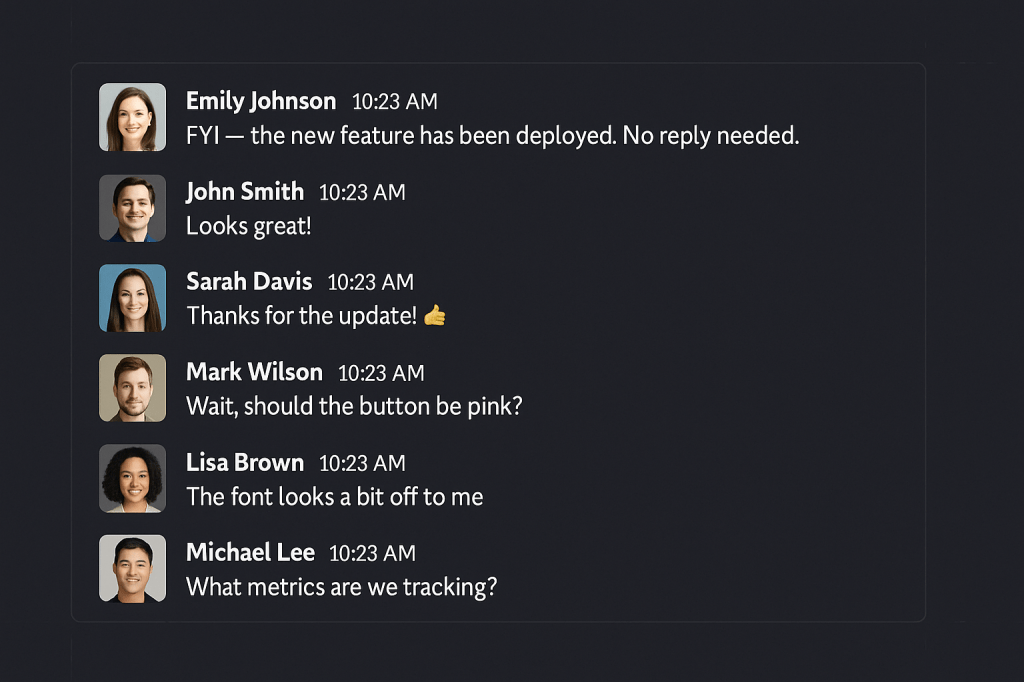
slack conversaion

7 pitfalls of Slack (and similar tools)

Slack and similar messaging platforms, like Teams and Mattermost, promised frictionless communication, faster collaboration, and a reprieve from endless email chains. And to be fair, they’ve delivered, but not without their own set of challenges. These communication platforms can just as easily cause dysfunction as they can drive productivity. Here are some common pitfalls.

1. Expectations of always being on

The problem:
Real-time chat fosters the illusion that everyone should be instantly reachable. That constant hum of notifications creates low-level anxiety and can kill deep focus. 

Example scenario:
Jasmine is a UX designer who starts working at 8:00 AM and wraps up by 5:00 PM. But her manager often messages her at 9:30 PM with “quick ideas.” Even though Jasmine doesn’t have to respond, she feels pressure to and it’s wearing her down.

Mitigation:
Normalize using Slack’s “Do Not Disturb” feature. Set team guidelines like “no messages after 6 unless urgent” and encourage scheduling messages with tools like Slack’s built-in delay feature. Confession: I spend way too much time on my laptop, and often respond to messages outside of regular hours. I’m even guilty of posting outside of those hours. However, there is no expectation that I expect a response at those times. (Note to self: I need to remind my team of this). 

2. Important info gets buried

The problem:
Slack can’t distinguish between what’s urgent and what’s just active. Critical updates often disappear under a pile of less important chatter.

Example Scenario:
The engineering team shares a Slack message in #product-news:
“API v1.2 will be deprecated in 30 days. All third-party integrations need to migrate to v2.0.”
Within a day, the message is swallowed by a stream of stand-up check-ins and demo GIFs. A partner success manager never sees the post and doesn’t notify a key enterprise customer,  resulting in broken integrations and an angry escalation.

Mitigation:
Use tools like Slack’s “Highlight Words” feature to alert people to terms like “deprecation,” “urgent,” or “migration.” Better yet, integrate Slack with your CRM or ticketing system to automate critical alerts to the right people since you should not rely on a single Slack message as your system of record.

How to set up Highlight Words, click your profile picture in the top right of Slack and select Preferences -> Notifications. Scroll down to My keywords and enter the words you want to track, separated by commas.

3. Slack becomes the default

The Problem:
Slack messages can easily be misread or misinterpreted, since you don’t see someone’s facial expression or hear their tone. Plus, they’re often very short.

Example scenario:
After a tense customer call, the customer success manager starts a thread criticizing the product team’s recent release. The product lead replies defensively. Within minutes, the conversation derails and now it’s visible to the majority of the company.

Mitigation:
Create clear guidance: feedback and conflict resolution should happen in 1:1 video chats or designated retrospectives. Use Slack for transparency, not tension.

4. It erodes focus

The problem:
Notifications and context-switching fragment focus, leaving team members busy but not productive.

Example scenario:
Daniel blocks off 9–11 AM for deep work on a strategy deck. But he gets pinged 8 times in 30 minutes with questions, requests, and check-ins. He never hits flow state and ends up working late to finish the deck.

Mitigation:
Support “focus hours.” Encourage team members to pause notifications, mute non-critical channels, and respect scheduled work blocks. Deep work should be protected, not penalized. I struggle with this often, as I have to resist the urge to respond, especially when someone pings me directly. When you feel like you can only be productive outside of work hours, it’s a problem that needs to be addressed.

5. Channel chaos

The problem:
When there are too many channels or unclear norms and naming conventions, people don’t know where to find or post what.

Example scenario:
Three team members post updates about the same client in #client-discussion, #sales-wins, and #random-client-notes. No one sees the full story, and someone accidentally duplicates work already done.

Mitigation:
Audit and consolidate your channels. Create clear naming conventions like  #client-[name], #proj-[initiative]), #success-help-and-feedback. Make a simple channel guide part of onboarding.

6. Unconscious exclusion

The problem:
Fast-paced Slack culture can exclude people who aren’t always online, aren’t native English speakers, or need more time to process and respond.

Example scenario:
During a fast-moving brainstorm in Slack, the extroverts dominate with rapid-fire messages. Maria, a thoughtful team member who prefers time to think before weighing in, ends up not contributing, even though she had a great idea the next morning.

Mitigation:
Encourage async participation. After a brainstorm, ask for additional input later in the day. Use threads and “summary” messages to recap discussions for those in other time zones or working styles.

7. The “reply reflex”

The problem:
In many Slack cultures, people feel pressure to acknowledge or respond to every message , even when the message is clearly just an FYI. What should be a quick, high-signal update turns into a noisy thread filled with tangents, opinions, and questions that don’t need to be answered.

Example scenario:
A marketer posts in #company-updates:
“FYI, the user conference microsite just went live! Feel free to share the link with customers. No reply needed.”

Within minutes, the thread fills up:

  • “Wow, I can’t believe it’s that time again already.”
  • “Looks awesome!”
  • “Does the pink color match the one on our main site?”
  • “The banner image looks a bit blurry.”
  • “What are we doing for SEO?”

What was meant to be a simple status update now feels like a kickoff meeting and creates extra noise for teams that aren’t even involved.

Mitigation:
Normalize the idea that not every update needs a response. Use “No reply needed” or “NRN” explicitly for FYIs. Encourage emoji reactions for lightweight acknowledgment. And when someone does need feedback or input, make that ask intentional and clear. Otherwise, help your team practice restraint and focus.

As powerful as Slack and other tools can be, they can also influence your culture in detrimental ways. Be mindful, and continue to establish ground rules and expectations. 

What about you? Which pitfalls have you experienced first hand and what helped you overcome them?